|

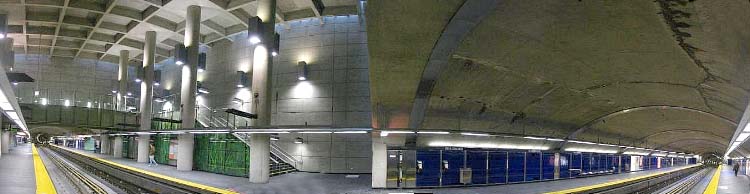
In something of a Cinderella story, the smallest station of the Laval extension and the one anticipated to be the least used is also the most beautiful, a coherent, innovative and graceful work of architecture.
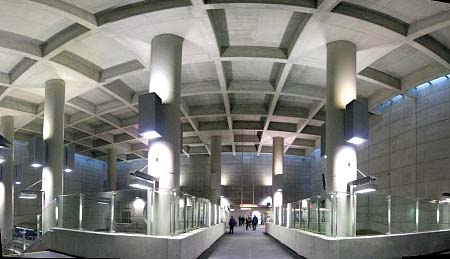
The station is composed of three basic geometrical elements: a block, a cylinder, and a cube. At the lowest level, the cubical main volume accents the traveller's pause on the way into the warren of metro tunnels.
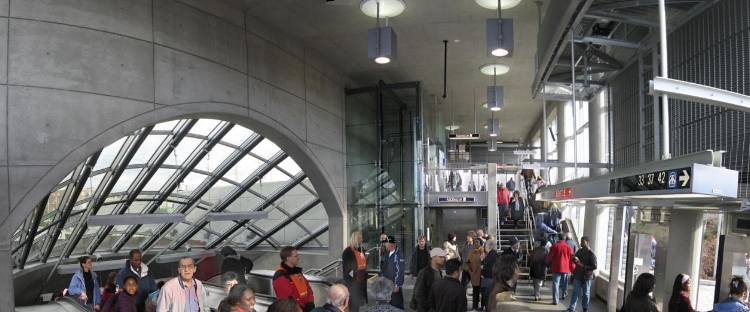
This is a graceful, calm space, its lofty pillars and ceiling rising high above the platform and transept. Lamps on the pillars and side walls shine both up and down, providing ample illumination while casting dramatic pools of light on the coffered ceiling. The artificial light is supplemented by rows of skylights around the whole perimeter of the cube. This layout means that the movement of the sun causes the illumination to shift over the course of the day, in essence making the entire central core into a sort of massive sundial.
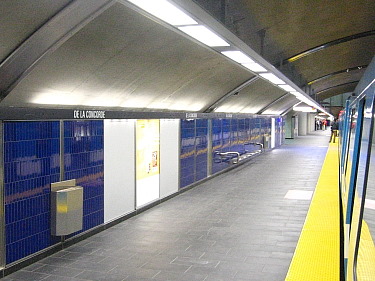
The tranquility is emphasized by the reliance on simple decoration with materials in their natural state: exposed concrete, glass, stainless steel, and the placid blue expanses of tiles.
 | 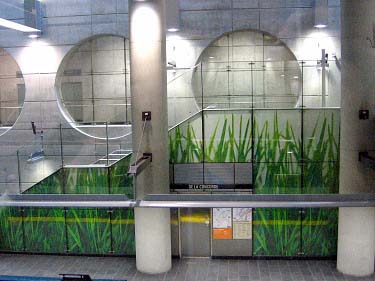 |
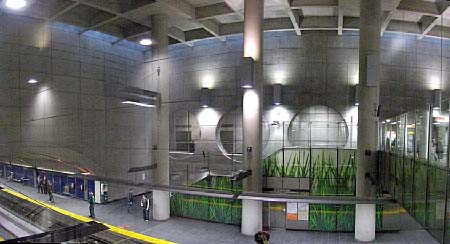
 A playful decorative detail at platform level: the safety glass over the stairs and bridge are extended to the floor of the platform, and enclose greatly magnified photographs of blades of grass. By giving the passenger the point of view of an ant, they play on the station's role as entrance to the huge underground warren of the metro system. They also evoke the landscaping above the station, as well as the metro system's growth into Laval from its roots in Montreal. Finally, the touch of nature under the sun of the skylight adds to the calm and grace of the volume.
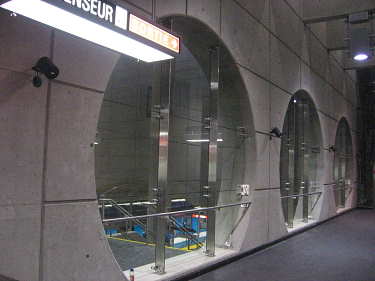
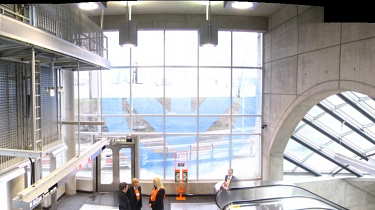
Another striking architectural detail are the three large circular windows that overlook the platforms from the corridor connecting the elevator access to the ticket hall.
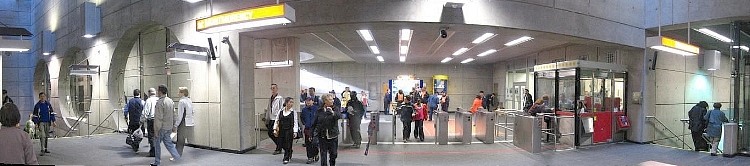
The transept-level ticket hall, alongside and separate from the central volume, is a relatively small space. It is the point of intersection between the cubical volume and the second of the station's striking geometrical forms: the cylinder.
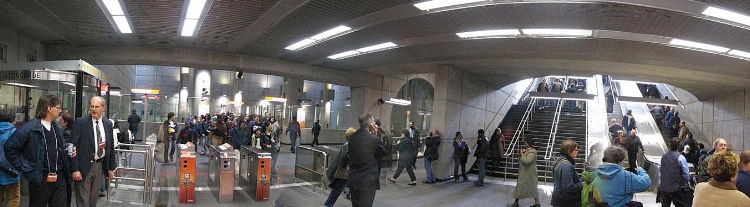
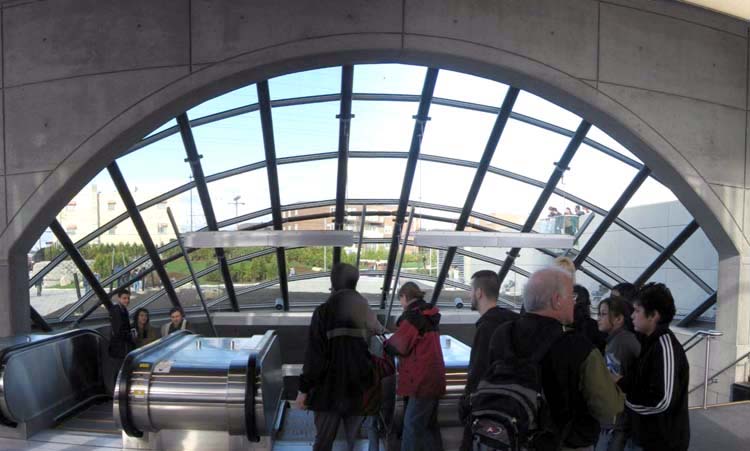
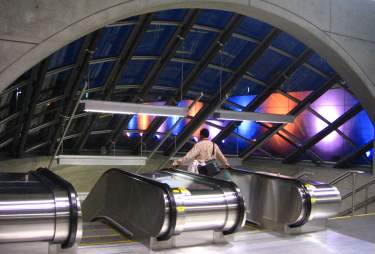
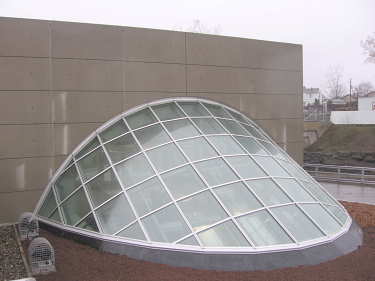 This tube containing the escalator shaft erupts from the ground just before reaching the entrance pavilion. This dramatic architectural feature has two functions. First, it floods the escalators with light, making it easier for passengers to orient themselves towards or away from the exterior. Second, it makes the flow of passengers up and down the escalators visible from outside, emphasizing the constant stream of motion into and out of the metro.
Unique in Montreal, this striking, ultramodern shape recalls Sir Norman Foster's famous Fosterito metro entrances in Bilbao.
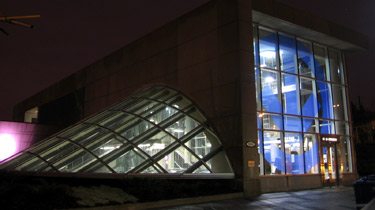
The uppermost of the station's forms is the elongated block that constitutes the split-level entrance pavilion offering direct access to a station on the Montreal/Blainville–Saint-Jérôme commuter train line. The front of the concrete and glass structure features a huge metro logo, an instantly visible and unmistakeable sign that firmly establishes the presence of the metro in its surroundings. This is reinforced at night, when the station's internal illumination causes it to blaze forth like a lantern.
 |  |
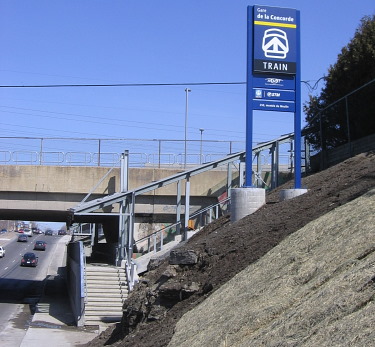
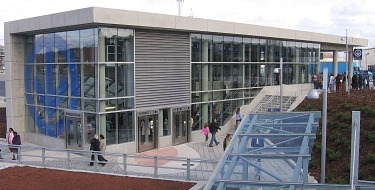
Built on a slope adjacent to the commuter train station, the entrance pavilion provides access at two levels: the upper level to the landscaped grounds, the kiss-and-ride area, and the outbound train station platform, and the lower level to the sidewalk on boul. de la Concorde and to the underpass towards the inbound train platform.
As the commuter train station is on a bridge over Boul. de la Concorde, access to the inbound platform is through a set of stairs on the opposite side of the overpass, reached via the sidewalk under the overpass. The outbound platform, adjacent to the station, can be accessed directly.
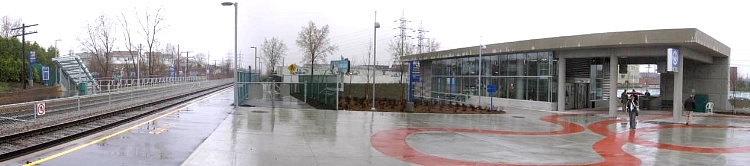
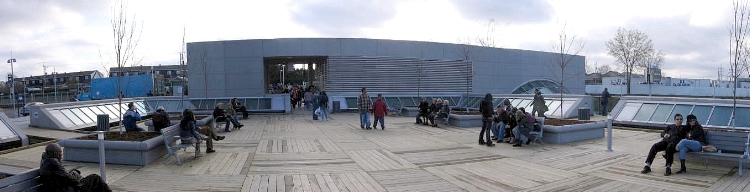
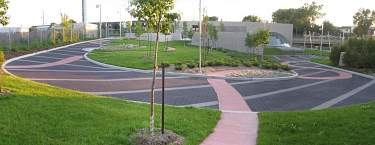 The area to the east of the station pavilion is landscaped, with paths and gardens laced with a circuitous thread in pink bricks. Most notably, the exposed roof of the cubical volume is set up as a terrace, with benches and trees, surrounded by the skylight entrances. At night, the station's artificial lighting shines out of the skylights, like a luminous crown.
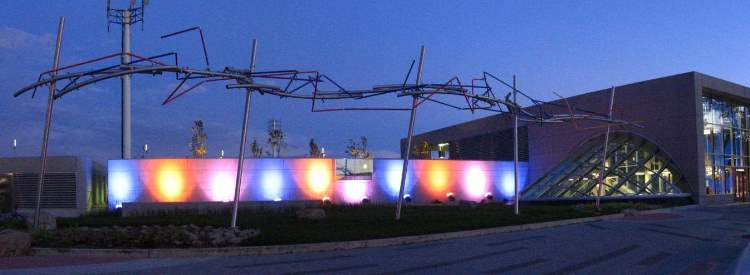
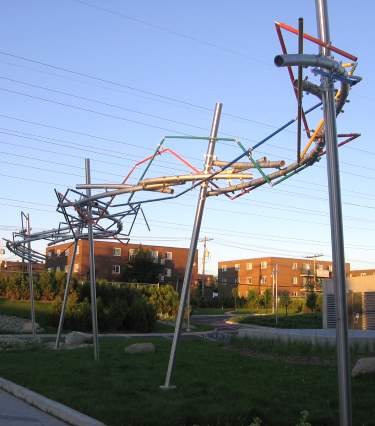
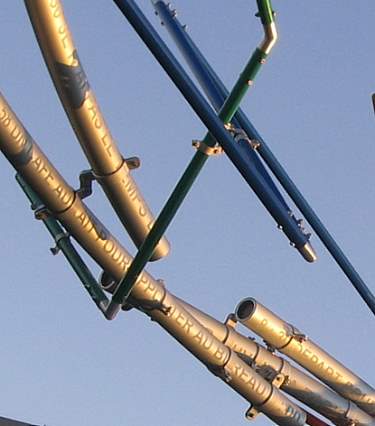
 The lower garden near the walkway toward the lower entrance is dramatically lit at night with blue, orange, and mauve uplights. These provide atmosphere for the station's artwork: a sculpture by Yves Gendreau entitled Nos allers-retours. This sculpture is composed of a tangle of coloured tubes in green, orange, yellow, and blue, the four colours of the metro lines, plus violet for the commuter trains. Intertwined with metal tubes etched with brief messages that suggest day planners, they symbolize the individual journeys of each passenger intertwining to form the network of the transit system as a whole.
 |  |
Every element has been used to its full effect in this jewel of a station.
| ||
|
