
|


Antique stained glass
Linear length 60 m × maximum height 9 m
Area 198 m²
Location: Champ-de-Mars station, kiosk

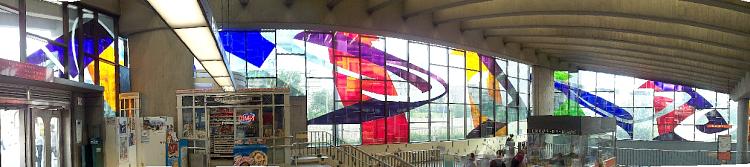
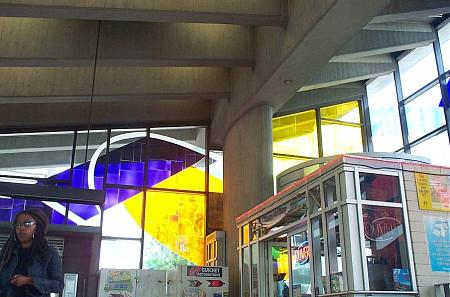
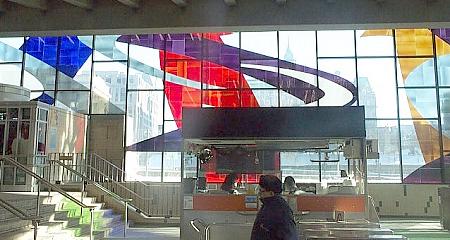
This sublime work, entitled Les grandes formes qui dansent according to a few sources, is not only one of the most beautiful works of art in the metro, but also one of this pre-eminent Quebec artist's most important masterpieces.
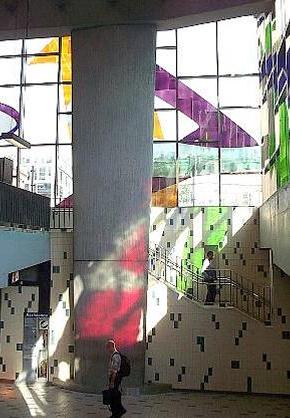
The multicoloured stained glass occupies three walls of the station's large kiosk and mezzanine, which is angled to receive sunlight best. The stained glass splashes pools of coloured light throughout the kiosk and onto the platforms.
These windows represent an artistic war story. Marcelle Ferron had met previously with Daniel Johnson père, premier of Quebec, to whom she expressed her interest in "turning metro stations into works of art." (Ferron 216) She was then contacted by Lucien Saulnier, Mayor Jean Drapeau's second in command, and given the contract to "give a soul to the Champ-de-Mars station [which was] ugly and depressing, and people avoided using it. It so disgusted people that some youths had vandalized it during a protest." (ibid., 217)
In order to sign the contract, she first had to meet with "a high-ranking civil servant" (ibid., 218) (a person she strongly implies in her book L'esquisse d'une mémoire was Robert La Palme, artistic director of the metro). This civil servant first told her that, instead of her abstract project, her windows should represent Louis-Joseph Papineau (see Cartier and Juhasz's Les Patriotes de 1837-1838), in keeping with the didactic historical art theme present elsewhere in the metro. He also requested that she pay $8 000 before the contract could be signed.
She flatly refused both conditions, and called Lucien Saulnier, who confirmed that she had complete freedom in her subject. "These reassurances so inspired me that I sat down at my desk and sketched all the windows for the metro in an hour." (ibid., 219)
Her struggles with the civil servant continued until, afraid of losing the contract altogether, she denounced the situation in a radio interview. Mayor Drapeau, who was about to call an election, quickly confirmed the project once and for all and moved the civil servant to a different department.
She worked with Superseal, a Saint-Hyacinthe company, to produce the windows; the antique stained glass itself was manufactured in Saint-Gobain, France, a centre of secret stained-glass techniques dating back to the Middle Ages. This mouth-blown glass (factory glass could not produce such luminous colours) was vacuum-sealed within flat glass panels, in an innovative technique..
Initially, collaborating with the Superseal manufacturers proved difficult due to sexism; however, she quickly endeared herself to the workers by following her political leanings and supporting them during a strike, despite possible delays to her project. Her project team was led by Roch Choquette. The CEO of Superseal after the strike, master glassworker Aurèle Johnson, later became her lifelong friend. The work was finally installed and dedicated in 1968, a $48 000 gift of the Quebec government.
Unfortunately, the work suffered more and more damage over the next thirty years, until it was in a pitiable state. In 1999, Aurèle Johnson directed its complete restoration using new techniques to seal and protect it, a project that won the STCUM a Prix Orange from Heritage Montreal. It is now as resplendent as ever.
I was tired of painting. So many collectors bought paintings and locked them in bank vaults. The stained-glass windows allowed me to make public art.... One day a woman stopped me in the street to talk to me about Champ-de-Mars metro station. "Whether it's sunny, rainy, or snowing, I love your stained-glass windows at Champ-de-Mars. Those big dancing shapes always warm my heart." That woman was neither a collector nor an art critic, but she understood the meaning I meant to give that work. (ibid., 222)
Bibliography:
Ferron, Marcelle, and Michel Brûlé. L'esquisse d'une mémoire. Montreal: Les Intouchables, 1996, pp. 217-222.